
Union County Warrant Checks
Union County publishes no sheriff warrant list, and Indiana offers no statewide criminal-warrant lookup anyone can browse. The best public starting point is Indiana MyCase, which shows public case information and docket events for courts across the state. Treat what you find there as context rather than proof. It will not certify that a warrant is active or inactive, so a solid warrant check moves from that online record to the office that controls or serves it. Keep a full name, date of birth, case or citation number, and any known hearing date private while you work. If the worry is your own possible warrant, call the court or a lawyer before you walk in. A phone call will not stop an arrest. It can tell you which office holds the case and what process the court permits.
- Search MyCase by case number when known, or use a careful party-name search.
- Read the docket for warrant, failure-to-appear, service, recall, quash, release, or hearing events.
- Call Union Circuit Court at (765) 458-5934 or the Clerk at (765) 458-6121 for court status.
- Call the Sheriff at (765) 458-5194 for non-emergency service, custody, or sheriff-record questions.
- Make a narrow records request for a specific non-confidential record, and seek legal advice before resolving an active matter.
Traffic cases add two more stops. The state ticket portal and BMV status can carry a Union County matter forward, but neither system replaces the issuing court.
Union County's Three-Office Route
Union County splits this work across three offices. The Circuit Court decides a warrant's status, and only that bench can recall or quash its own order. The Clerk maintains filings, judgments, orders, and docket material. The Sheriff serves warrants and keeps separate service, jail, and custody records. Each office may hold a different piece of the event.
Union Circuit Court
26 West Union Street, third floor
Liberty, IN 47353-1347
(765) 458-5934
Use for court instructions, hearings, and the issuing judge's order.
Union County Clerk
26 West Union Street, first floor
Liberty, IN 47353-1347
(765) 458-6121
Use for case files, dockets, filings, and copies.
Union County Sheriff
106 East Union Street
Liberty, IN 47353
(765) 458-5194
Use for service, custody, and sheriff records.
The official office directory places these contacts in one source.
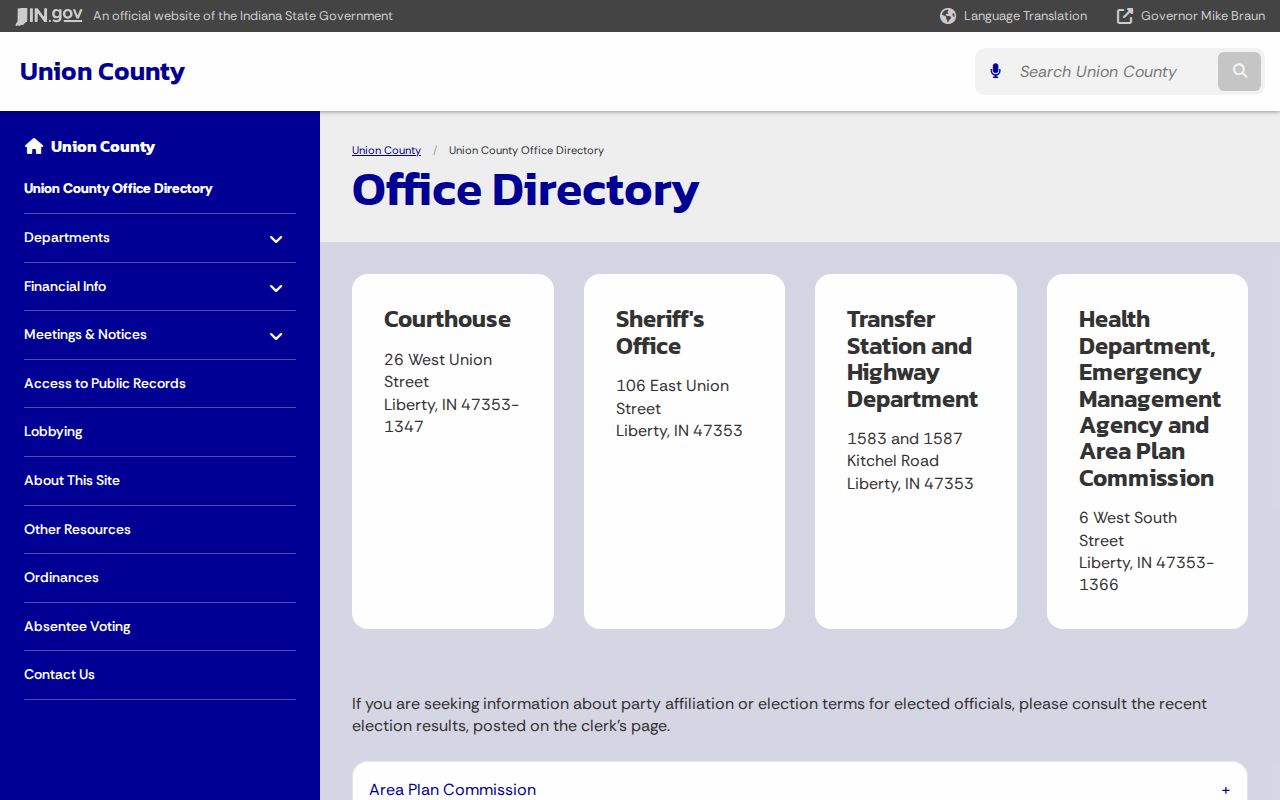
The directory shows why a warrant inquiry must be routed by record type.
Warrants in Union County: Main Types
"Warrant" covers more than one kind of order in Union County. Indiana law separates orders to arrest a person, orders tied to a missed appearance, and authority to search a described place or thing. A summons, civil paper, tax warrant, and BMV suspension run through other systems entirely. The case and the issuing court show which process applies.
| Warrant Type | How It Arises | Who Issues It |
|---|---|---|
| Arrest warrant | A criminal charge and probable-cause process support an arrest order. | A judge or authorized court officer |
| Bench warrant | A person misses court or fails to meet a judicial requirement. | The judge handling the case |
| Search warrant | A sworn showing supports a search of a described target. | A judge |
| Traffic FTA warrant | A person fails to appear; a separate BMV action may follow. | The court handling the ticket |
Two cautions follow from that. A search warrant does not command the arrest of every person present. A recalled Union County bench warrant may still sit in the docket as an old event.
No Union County Warrant Roster
No public active-warrant roster exists for Union County. The official Sheriff website links to jail information, a tip channel, and MyCase, but it advertises no warrant lookup. An inmate search only tells you who is in custody. It cannot prove that a person outside the jail has no warrant. The Sheriff's published contact information offers a direct official route instead.
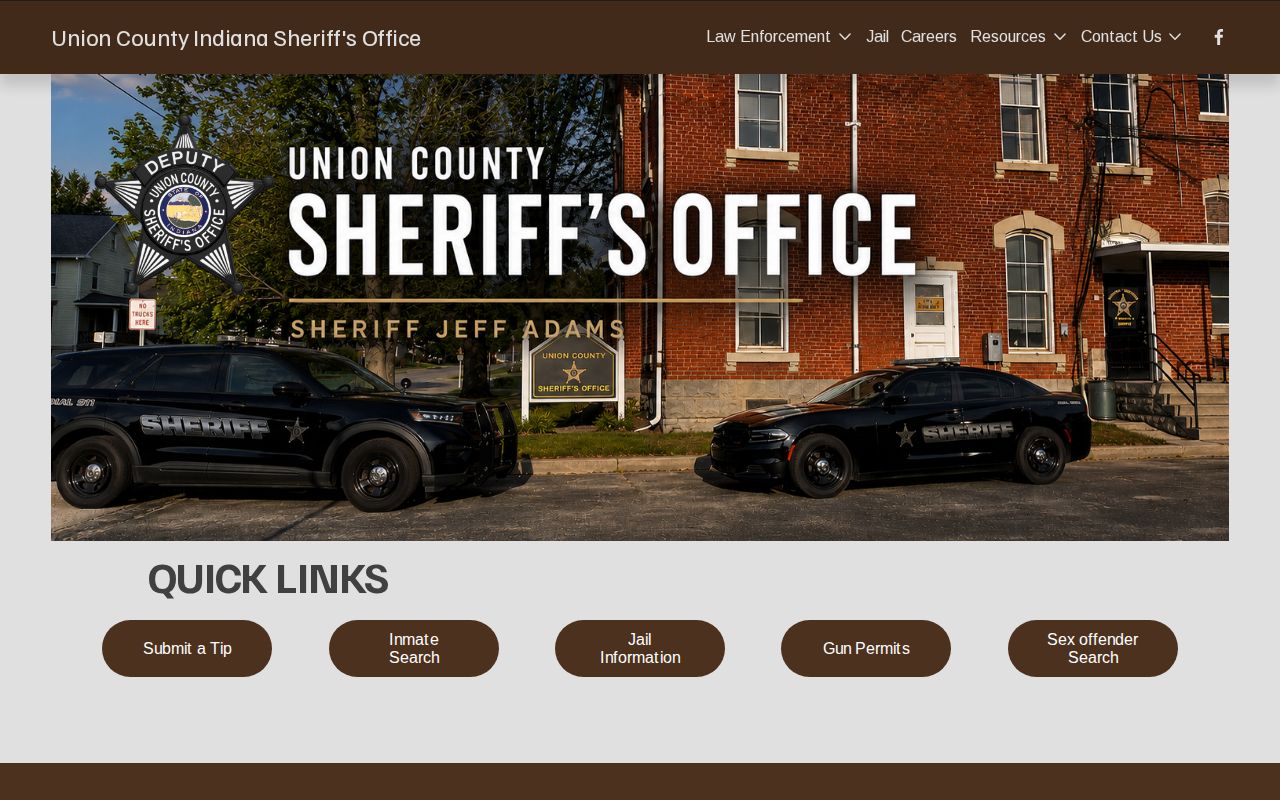
That same page supports calling the Sheriff's non-emergency number to get routed. Reserve 911 for a Union County emergency.
No result is not clearance.
A missing name may reflect spelling, the wrong court, restricted material, changed status, or an event not published online.
Union County Warrant Records: Contents
A warrant record can carry several dates and statuses. The issue date is not always the date police received or served the order. A service return may sit with the Union County Sheriff while the judicial event appears in the Clerk's file.
| Case Number | The court identifier, such as 81C01-26-CM-000123, used for MyCase and Clerk contact. |
|---|---|
| Warrant Type | Arrest, bench, search, probation, traffic FTA, or another kind. |
| Issuing Court | The court that decides if the order stays in force. |
| Charge | The allegation tied to the case, not a finding of guilt. |
| Issue Date | The date issued, which may differ from entry and service dates. |
| Bail or Bond | An amount or condition if set; current terms need direct confirmation. |
| Status and Return | Issued, served, returned, recalled, or quashed events. |
MyCase shows public case information, not every source document in a Union County file. Sealed, confidential, and expunged material stays outside public view.
MyCase Events and Warrant Status
A MyCase warrant check works best when you already hold a case or citation number. A name search can find context, but common names and spelling variants can pull up a broad result set, so use the court, case-status, and filing-date filters. The portal caps how many results it returns, which means an overbroad query can hide some matches. A date of birth can narrow a Union County search even though it is not shown publicly. Read the full docket, not just one line. A past "warrant issued" entry may be followed by service, recall, quash, or a hearing. Recall means the court withdrew the warrant; quash means it nullified the warrant. Neither term guarantees the case closed, so the Clerk or Circuit Court gives current, case-specific confirmation. When nothing appears, check your spelling, a reasonable variant, the court, and the date range. Then call the court. Never treat a failed search as proof that no Union County warrant exists.
Union County Warrants: Issued and Served
Warrants in Union County start with the Union Circuit Court. A judge signs one and only a judge can later recall or quash it. The Clerk keeps the case file and accepts filings, but that office never acts as the judge. The Sheriff does the serving. Union County's county Sheriff page lists serving warrants and civil process among the sheriff's duties.
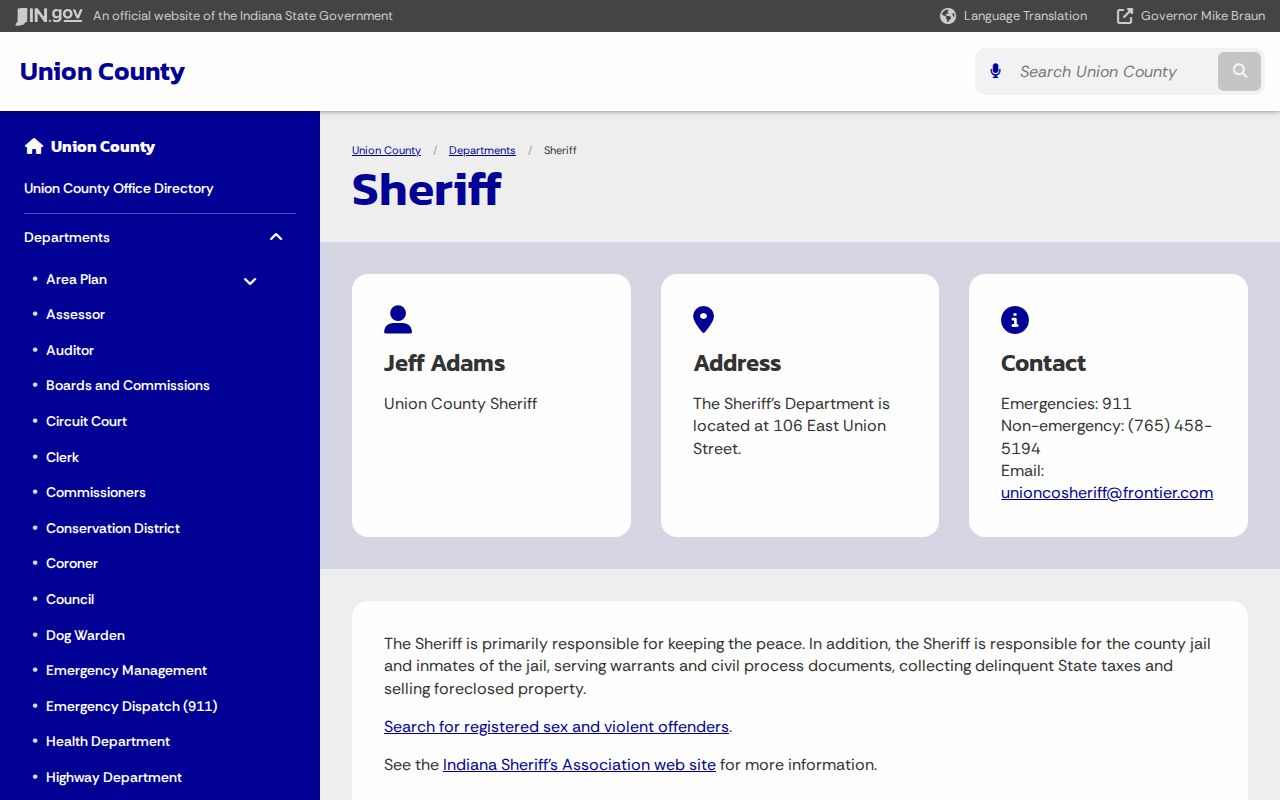
The line between the offices is practical. A Union County sheriff addresses execution or custody, but only the court changes its own order. Note: Civil process and criminal warrant service share an agency, but they are different documents with different legal effects.
Two Union Street Destinations
Liberty's courthouse and Sheriff's office sit at separate Union Street addresses. Court status, docket, copies, and judicial procedure start at the courthouse. Service, jail, custody, and sheriff-record questions start with the Sheriff. Call before you travel. No source confirms parking, security screening, after-hours intake, or a walk-in process for clearing a Union County warrant. The official county page identifies Liberty as the county seat and lays out the department structure.
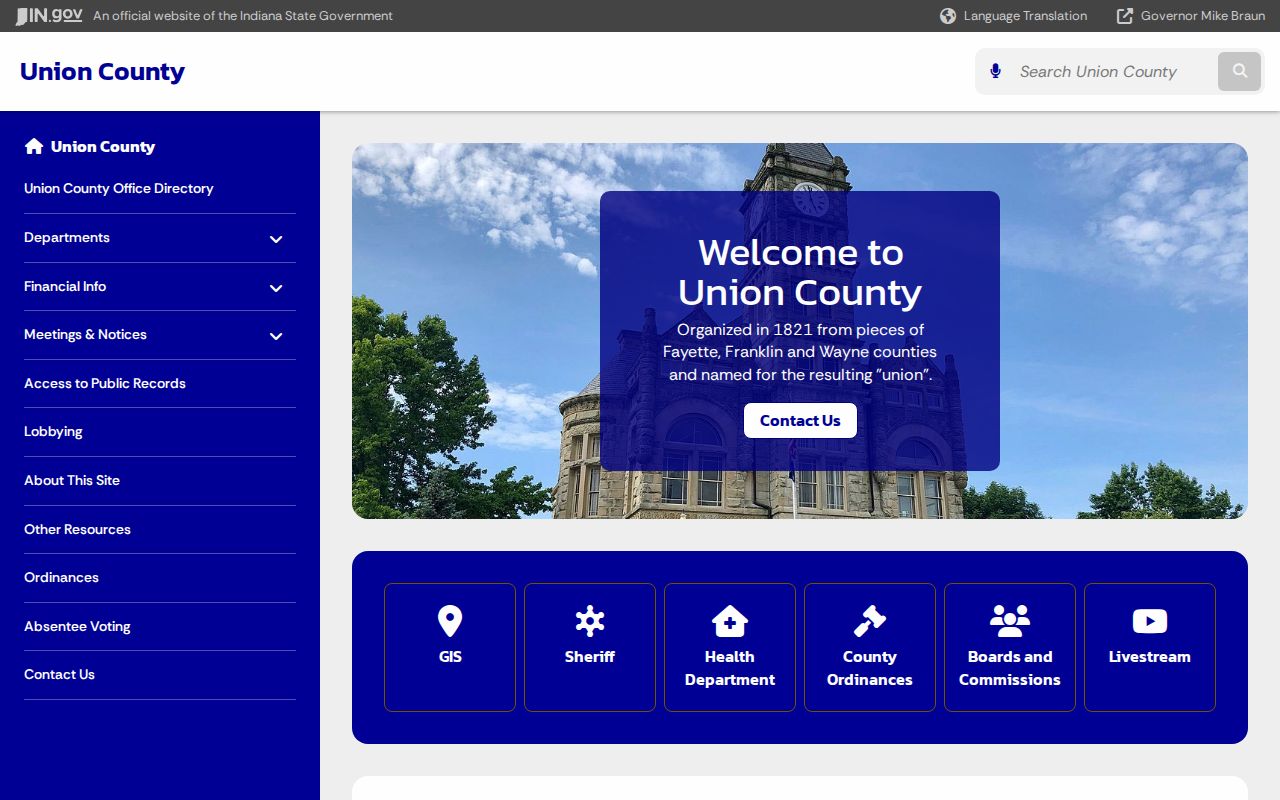
The page supports using named departments rather than assuming a public “warrant desk” exists.
Handling a Union County Warrant
Start by identifying the issuing court and case number. Ask the Union County Clerk or Circuit Court what can be confirmed and which procedure applies. Counsel can weigh a set appearance, a motion to recall or quash, voluntary surrender, compliance, or a bond process. The judge alone decides whether the warrant changes.
Call first and plan safely.
Do not assume that walking into court, paying online, or getting a new date will recall a warrant or ensure release.
Paying a traffic fine or other money owed can settle part of a case. Still, Union County drivers should know payment alone may not recall a warrant, and it can carry legal effects. A bond amount can shift too. Hold on to receipts, court orders, notices, and anything from your attorney. When the case touched your license, clear the court duty first, then handle the BMV. The Union Circuit Court page has the official contact. For advice on your own situation, a lawyer beats any public record.
Union County Traffic Warrant Boundaries
One traffic problem in Union County can span three systems at once. The ticket case is one. A failure-to-appear event in court is another. A BMV suspension is a third. They connect, but they answer different questions. Indiana ePay searches eligible ticket data. MyCase shows public case context. BMV records show suspension status. None of them amounts to a full Union County warrant list. When a suspension flows from a court order or a failure to appear, the BMV tells the driver to contact the court first. The court handles the appearance and the case outcome, then sends notice. An indefinite FTA suspension holds until the needed court notice or disposition, though that entry alone does not prove an active warrant. Do not pay a ticket just to test your status. Indiana ePay warns that payment may count as a judgment, an admission, or a no-contest disposition. Instead, use the ticket and case number to ask the court what is still due.
Warrant Access Under Indiana Law
Indiana sets the ground rules for warrant access. The Access to Public Records Act and the Indiana Rules on Access to Court Records govern what is open. Records are public unless a law restricts them. Warrant files can contain private identifiers, victim data, investigative material, sealed affidavits, source details, or officer-safety content. A custodian may redact a section, withhold restricted parts, or point you to a different office. The Union County access page tells you to contact the official responsible for the record. Describe what you want: the record, the custodian, a case number or date range, and whether you seek inspection or copies. Ask about cost up front. A demand for “all warrants” may be too vague to answer.
Access is not instant production.
Response periods concern acknowledgment, while an office may need time to find, review, redact, and produce records.
A denial from Union County should state its basis and the official behind it. “Not maintained here,” “not located,” and “not public” each mean something different.
Small-County Warrant Routing
Union County counted 7,087 residents in the 2020 Census and holds two incorporated towns. At that scale, the practical warrant search is a state case portal plus direct county offices. No local dashboard fits the job. No office here publishes a warrant-count report, so jail totals or MyCase hits cannot estimate how many warrants exist.
In Union County, precise routing beats an unverified name match. A case, a service return, a ticket, and a BMV entry can all relate to one person while answering different questions.
City Warrant Records in Union County
Union County contains two incorporated places: Liberty and West College Corner. Neither town runs its own warrant portal. Town lines do not set your status. The issuing court and the record custodian do. Residents rely on MyCase plus the Union County court, Clerk, and Sheriff.
Liberty
The county seat holds the courthouse and Sheriff offices. Its town site gives municipal context, not warrant records.
West College Corner
No standalone town warrant or court portal was found. County offices in Liberty are the route.
West College Corner, Indiana is not College Corner, Ohio. In any Union County search, pick Union County and Indiana on purpose.
Union County Warrant Terms
Short docket labels in Union County can hide key changes. These terms help frame a court call, but the current order always controls.
- Active
- A warrant believed to remain enforceable; public display may not prove current status.
- FTA
- Failure to appear, which may lead to a bench warrant and a separate traffic consequence.
- Recall
- A court act withdrawing a warrant; the case may remain open.
- Quash
- A court act nullifying a warrant; confirm the next duty.
- Return
- A law-enforcement record of service or execution.
- Redaction
- Removal of protected content while lawful parts are released.
In Union County records, issued is not the same as served, and served is not the end of the story.
Federal and Tax Warrant Limits
A federal criminal warrant never appears in MyCase. Union County sits in the Southern District of Indiana, where federal case context comes from the federal court and PACER. Sealed details may stay closed. A match on a federal docket does not promise an open operational warrant record. The U.S. Marshals Service, not the county Clerk, executes federal warrants. Indiana tax warrants run through a separate system. That one is about tax collection, not a criminal check. Civil process served by the Union County Sheriff is distinct as well. These lines keep a tax lien, summons, subpoena, protection-order paper, or BMV suspension from being mistaken for an arrest warrant. The word “warrant” alone never picks the portal or office for you. When a record points to federal court, use PACER or the Southern District Clerk for eligible docket access. Questions about federal execution go to the U.S. Marshals Service. A blank county search is not federal clearance. County court staff are not custodians of a federal case, even when the event happened in Union County.
Tax-warrant access can also demand authentication or a subscription, because it serves a collection system rather than the open criminal-case search. Read a tax record through the Department of Revenue and the court-administration sources that keep it. The Sheriff may serve civil papers in the same county, but service by one agency does not turn those papers into criminal warrants. Ask what kind of record a document names before assuming arrest authority. For a local criminal or traffic concern, stay with the Circuit Court, the Clerk, the Sheriff, and the official state court tools. Start with the jurisdiction written on the notice, ticket, or case record. If that source is unclear, ask the Clerk to identify the court instead of sending private details to many agencies at once. A narrow question protects privacy and is easier to route. Every system carries its own access rules, dates, and record custodian, so one result can never declare the status of another. In Union County, that caution applies to every office you call.